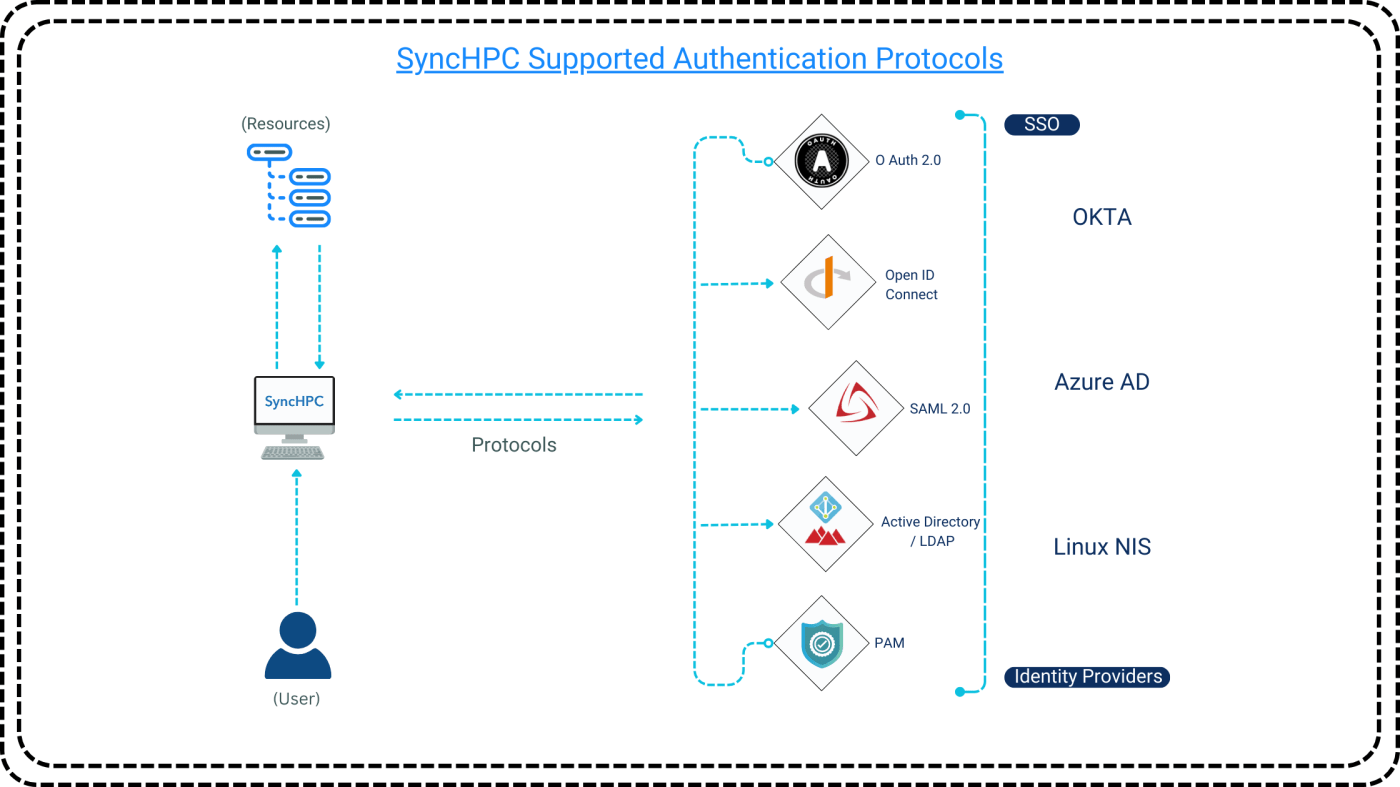
Authentication is the cornerstone of secure and efficient access to any platform. It ensures that only authorized users can access resources, thereby safeguarding data and workflows. In the context of High-Performance Computing (HPC), Artificial Intelligence (AI), and Virtual Desktop Infrastructure (VDI), secure authentication is even more critical due to the sensitivity of data and computational resources involved. SyncHPC, a hybrid platform for running HPC, AI, and VDI workloads, integrates various authentication methods to meet diverse organizational needs. Its pluggable architecture allows seamless integration of multiple authentication types, providing flexibility and enhanced security for users.
Identity Providers in SyncHPC
Identity providers (IdPs) are services that verify a user’s identity and enable secure access to applications and resources. By centralizing authentication, IdPs streamline access management, improve security, and provide a better user experience. SyncHPC integrates with several leading identity providers to cater to diverse organizational needs.
Single Sign-On (SSO): Single Sign-On allows users to log in once and gain access to multiple applications and services without re-entering credentials. This improves user convenience and reduces password fatigue, all while maintaining robust security. SyncHPC supports SSO through protocols like SAML and OpenID Connect, ensuring a seamless and secure login experience across workflows.
Linux NIS: The Network Information Service (NIS) is a traditional identity provider commonly used in Linux environments. It simplifies the management of user credentials and permissions across a network. While NIS is valuable for legacy systems, SyncHPC also provides modern alternatives like Okta and Azure AD, ensuring compatibility and flexibility for diverse organizational setups.
Okta: Okta is a leading Identity-as-a-Service (IDaaS) provider offering adaptive multi-factor authentication (MFA), user lifecycle management, and seamless SSO. Its cloud-based architecture makes it a versatile choice for organizations embracing modern identity management. SyncHPC integrates Okta effortlessly, enabling secure access and streamlined management for hybrid workloads.
Azure Active Directory (Azure AD): Azure AD is a cloud-based identity provider that offers enterprise-grade access management and security. Deeply integrated with Microsoft’s ecosystem, Azure AD provides features like conditional access, MFA, and device compliance policies. SyncHPC supports Azure AD integration, making it an ideal choice for enterprises heavily invested in Microsoft technologies. This integration allows businesses to leverage advanced identity management capabilities for their HPC, AI, and VDI workloads.
Types of Authentication Integrated with SyncHPC
SyncHPC supports multiple authentication methods, providing flexibility and enhanced security for organizations. Below are the supported types of authentication and their ease of integration:
Password Authentication (PAM)
- Overview: SyncHPC’s own pluggable authentication module (PAM) ensures basic but robust user verification for those without external integrations.
- Ease of Integration: Built-in PAM authentication requires minimal setup, making it a default choice for simple configurations.
LDAP Authentication
- Overview: A centralized authentication system that enables organizations to manage user access across multiple systems efficiently.
- Configuration Parameters: Enterprise Active Directory (AD) Server and Enterprise Domain Name.
- Ease of Integration: Specify the AD server address and domain name, and SyncHPC automatically manages user and group synchronization.
AzureAD Authentication
- Overview: A cloud-based identity and access management service from Microsoft, perfect for businesses leveraging Azure infrastructure.
- Configuration Parameters: Client AD, Authority, Redirect URI, Cache Location, Store Auth State in Cookie, Protected Resource Map, AzureAD Metadata Endpoint, AzureAD Client Secret, and AzureAD Tenant ID.
- Ease of Integration: Simply provide these configuration details, and SyncHPC connects to AzureAD to enable seamless SSO and secure user access.
Okta Authentication
- Overview: A widely used Identity-as-a-Service (IDaaS) solution, offering single sign-on (SSO) and adaptive multi-factor authentication (MFA).
- Configuration Parameters: Issuer, Client ID, Redirect URI, Scopes, and OKTA Metadata Endpoint.
- Ease of Integration: Add the issuer and metadata endpoint, and
OpenID Authentication
- Overview: An open standard for decentralized authentication that simplifies user access while maintaining security.
- Ease of Integration: OpenID settings are minimal, requiring basic configuration for decentralized authentication.
SAML Authentication
- Overview: A protocol that enables SSO by securely transmitting authentication data between an identity provider and a service provider.
- Configuration Parameters: Metadata URL and Issuer.
- Ease of Integration: Enter the metadata URL and issuer details to enable SAML authentication for secure and federated access.
Benefits of Authentication in SyncHPC
- Enhanced Security: Protects sensitive data and computational resources from unauthorized access.
- User Convenience: Single sign-on (SSO) methods reduce the need for multiple login credentials.
- Scalability: Accommodates large-scale user bases with centralized and automated authentication processes.
- Flexibility: Offers a wide range of authentication integrations tailored to organizational requirements.
- Regulatory Compliance: Helps organizations meet stringent data protection and compliance standards.
- Improved Collaboration: Centralized authentication facilitates seamless collaboration among diverse teams, including data scientists, engineers, and HPC users.
Conclusion:
In a world where data and computational power drive innovation, ensuring secure and seamless access is paramount. SyncHPC addresses this need by offering a robust authentication framework that supports various authentication methods. This flexibility and security make SyncHPC a reliable platform for organizations striving to integrate HPC, AI, and VDI workloads into their operational workflows. With SyncHPC, businesses can confidently focus on their analytical and computational goals, knowing their access systems are secure, efficient, and scalable.
 blog.syncious.com
Leave a comment