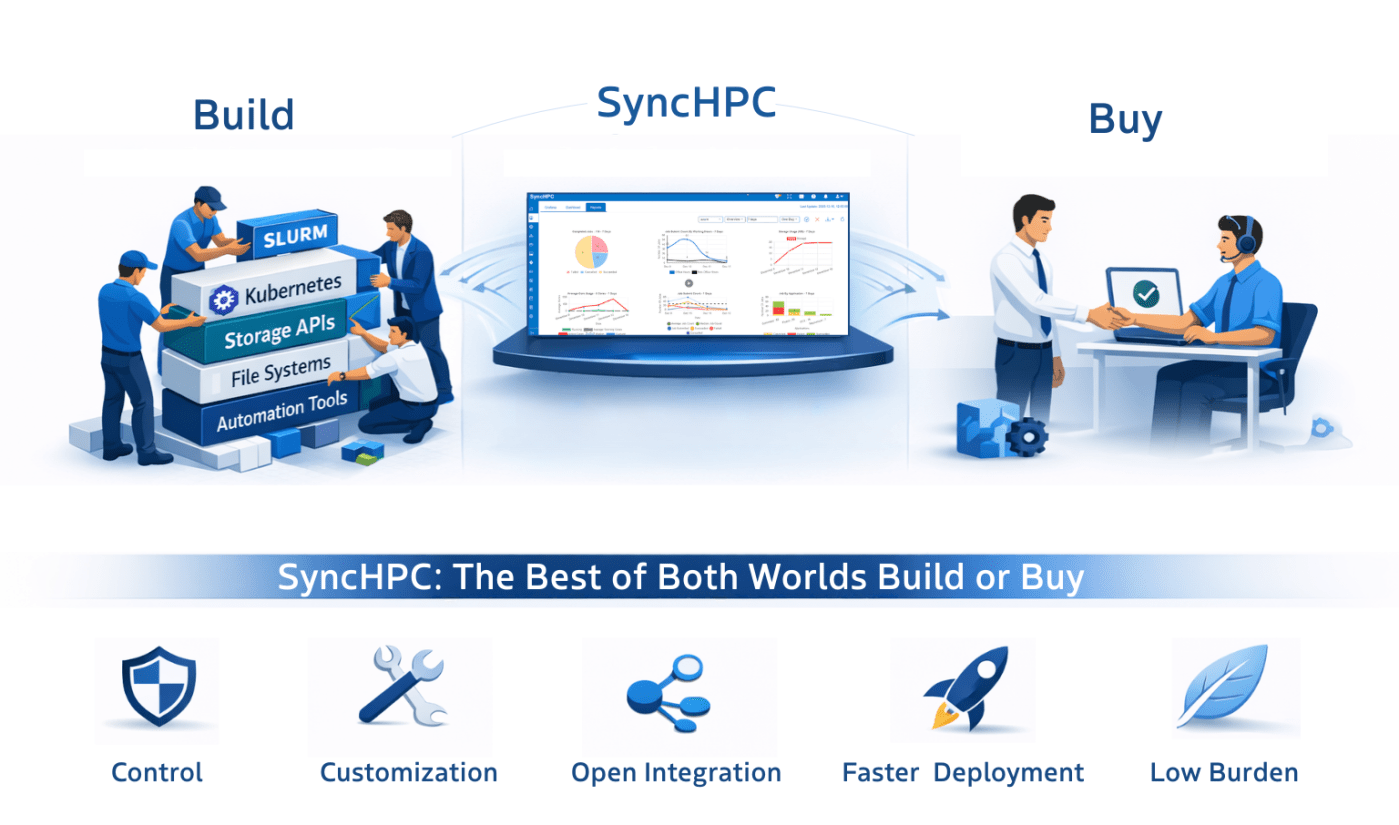
Many organizations assume that buying a platform means sacrificing flexibility. They believe that once they adopt a ready-made solution, they will lose control over architecture, workflows, and innovation. This is why many companies initially consider building their own HPC orchestration platforms, even though it requires significant time, resources, and engineering effort.
However, modern platforms like SyncHPC challenge this assumption. SyncHPC is designed to combine the control and flexibility of a custom-built platform with the speed and efficiency of a ready-to-deploy solution.
Organizations can still maintain full control over their infrastructure, create custom workflows, innovate their computing processes, and retain ownership of their automation logic without the burden of developing and maintaining the platform themselves.
When Organizations Choose to Build
Some companies prefer building their own infrastructure stack when their requirements are highly specialized or when they want full ownership of their platform, data, and functionality benefits they often assume would be compromised by buying a ready-made solution. Generally, the key building blocks like Job Scheduler (like Slurm), container platforms (like Kubernetes) and other building blocks are open-source. Hence, organisations tends to build their own solution management platform.
SyncHPC is a pluggable platform where admins can create their own custom solutions and workflows. In fact, SyncHPC is built to have the benefits of ownership of solution. Along with this, it overcomes the challenges of building your own platform. Also, SyncHPC is built on the industry standard components like Slurm, Kubernetes, Multiple filesystems, Storage APIs and other HPC and AI tools.
Benefits of Building your own:
1. Full control over features and architecture
A major reason organizations build their own infrastructure is to maintain complete control over system architecture and features.
With SyncHPC, organisations still retain this control. It allows teams to configure infrastructure based on their specific requirements. They can define how their compute clusters, storage systems, applications, and workloads interact within their environment. Instead of enforcing a rigid architecture, SyncHPC enables teams to deploy, manage, and scale their infrastructure while maintaining architectural ownership.
2. Custom workflows tailored to internal processes
Every organization has unique engineering or research workflows. Many companies choose to build internal platforms because they want full control over how their workflows operate. SyncHPC supports pluggable architecture and customizable workflows, allowing teams to design and automate their own processes.
3. No vendor lock-in
Vendor lock-in is one of the biggest concerns when adopting enterprise platforms. Organizations worry that once they commit to a solution, they may lose control over their workflows or infrastructure. SyncHPC addresses this concern by ensuring that organizations retain ownership of their workflows and automation scripts. SycnHPC’s core backend is fee for use with open APIs.
Even after the lock-in period ends, organizations still have access to the workflows and processes they created within the platform. While they may lose access to the SyncHPC GUI (Graphical Interface), but their workflows can continue to operate using scripts and automation tools. It ensures that organizations remain in control of their infrastructure and operational logic, rather than being permanently dependent on the platform. Even, admins can build their own GUI with the APIs provided by SyncHPC-Core backend.
4. Ability to create unique competitive capabilities
Organizations often build internal platforms to create unique capabilities that differentiate them from competitors. SyncHPC does not standardize or restrict how organizations design their computing workflows. Instead, it provides a powerful infrastructure foundation that allows teams to build their own specialized workflows and innovation pipelines.
Engineering teams, researchers, and data scientists can continue experimenting, integrating new tools, and optimizing their workflows according to their specific requirements. This ensures that organizations can still develop unique processes, specialized workflows, and competitive advantages, without the need to build an entire infrastructure platform from scratch.
Challenges of Building Own: How SyncHPC Helps Overcome Them ?
While building an internal platform provides control and flexibility, it also introduces significant operational and technical challenges. Developing and maintaining an enterprise-grade HPC orchestration platform requires substantial resources, time, and expertise.
1. High Upfront Development Cost
Building an HPC orchestration platform requires significant investment in development, infrastructure design, and testing. Organizations often need to allocate dedicated engineering teams, purchase specialized hardware, and invest in long development cycles before the platform becomes operational.
With SyncHPC, organizations avoid these high upfront development costs. The platform provides a ready-to-deploy orchestration layer that integrates with existing infrastructure, allowing companies to leverage a proven system without investing heavily in building one from scratch.
2. Long Development Cycles
Developing a reliable enterprise platform can take months or even years. During this time, engineering teams must design architecture, build core features, test scalability, and ensure system reliability.
SyncHPC significantly reduces this timeline by providing a pre-built orchestration platform that can be deployed quickly. Organizations can start running HPC, AI, and VDI workloads much faster, enabling teams to focus on innovation rather than platform development.
3. Continuous Maintenance and Upgrades
Building a platform is only the beginning. Organizations must continuously maintain the system, release updates, fix bugs, manage security patches, and adapt the platform to new technologies.
SyncHPC removes much of this operational burden. Platform improvements, optimizations, and updates are handled within the ecosystem, allowing organizations to benefit from continuous innovation without dedicating internal teams to platform maintenance.
4. Need for Specialized Engineering Teams
Operating a custom HPC orchestration platform requires specialized expertise in areas such as cluster management, scheduling systems, GPU orchestration, infrastructure automation, and system monitoring.
SyncHPC reduces the dependency on large specialized teams by providing built-in orchestration, automation, and management capabilities. This allows organizations to operate advanced computing environments without needing to build and maintain deep infrastructure expertise internally.
When Organisations Choose to Buy
Buying a platform allows organizations to adopt ready-to-use solutions. Buying software can significantly reduce time-to-market since the solution is already developed and tested. Following are the benefits of buying a ready-made platform like SyncHPC:
- Faster deployment
- Lower initial investment
- Vendor-provided updates and support
- Proven technology already used by other organizations
SyncHPC is the Best of Both Worlds Build or Buy
As discussed, both challenges and opportunities of building your own platform can be facilitated by SyncHPC. Along with that SyncHPC provides benefits of buying an industry standard platform. Hence, SyncHPC offers the ideal middle ground a powerful platform that combines the flexibility of custom infrastructure with the efficiency of a ready-to-deploy solution. If your organisation is looking to simplify HPC operations, accelerate AI workloads, and maximise infrastructure utilisation, SyncHPC is the smart choice.
 blog.syncious.com
Leave a comment