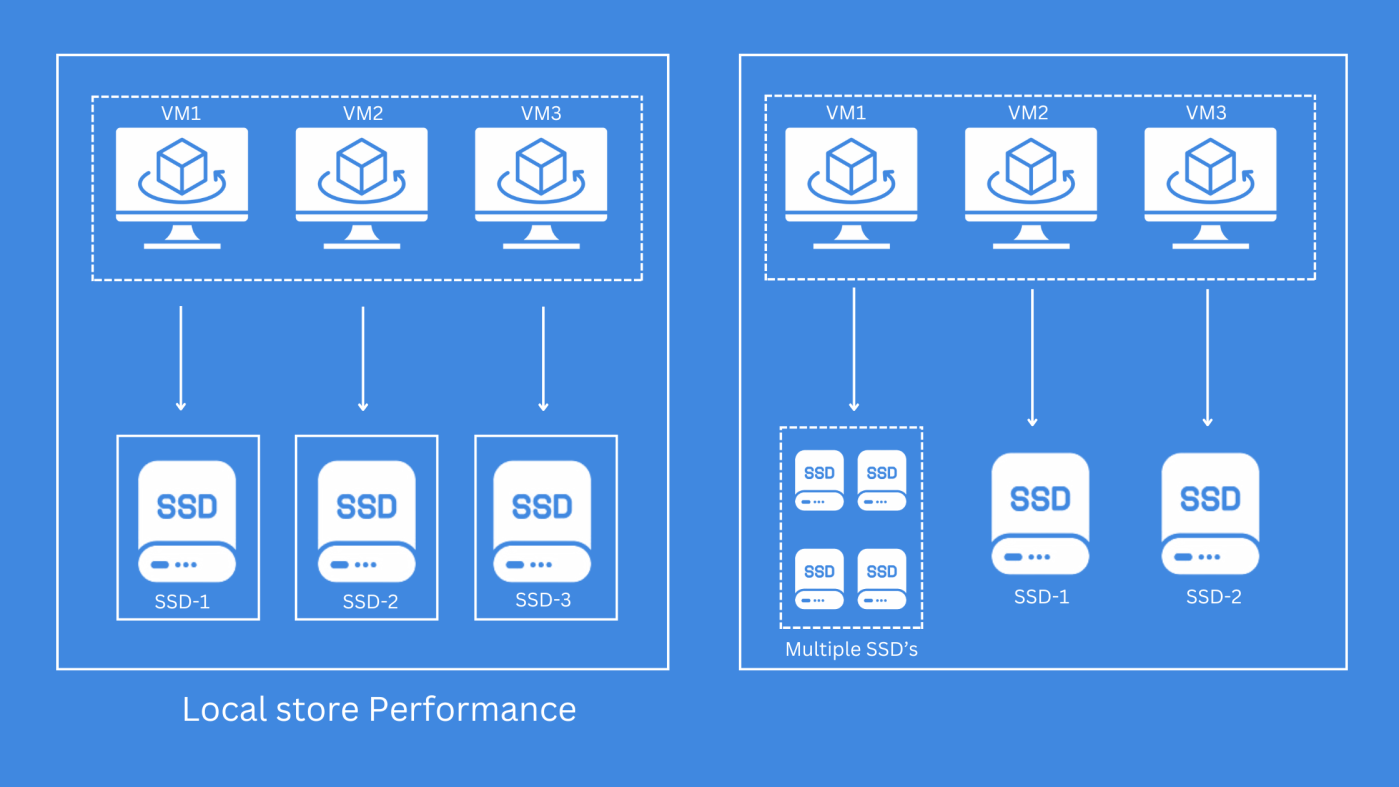
What is Local Store?
In High-Performance Computing (HPC), a local store refers to a storage mechanism that is directly accessible and optimized for the computational tasks being performed on a specific node or processor. It is designed to provide fast read and write access for frequently used data, minimizing latency and bandwidth issues associated with accessing remote storage systems. Especially in complex simulations and data-intensive tasks, as they reduce the overhead of data transfer between nodes and the central storage.
Key Features of Local Storage in HPC:
- Direct Access: The storage is physically attached to the node (e.g., via SSDs, HDDs, or other devices). This allows for low-latency and high-speed data access, making it ideal for tasks that require fast read/write operations.
- Temporary Data: Local storage is typically used for temporary or intermediate data that is generated during computations. Once the computation is complete, this data is often discarded or transferred to a more permanent storage system.
- Types of Local Storage:
- Hard Disk Drives (HDDs): These are slower but offer larger storage capacities at a lower cost.
- Solid-State Drives (SSDs): Faster and more durable than HDDs, SSDs are commonly used in HPC for high-performance tasks.
- RAM (Random Access Memory): In some cases, memory-based storage like RAM is used as ultra-fast temporary storage, although it is volatile (i.e., data is lost when the node is powered off).
Benefits of Local Storage in HPC:
- Performance: Local storage provides fast access to data since it is physically located within the node, eliminating the need to access data across the network or from a shared system.
- Low Latency: Data can be processed quickly without waiting for network communications or delays inherent in accessing remote storage.
- Autonomy: Each node can store and access its data without competing for resources on a central file system, which can reduce bottlenecks and enhance performance in large-scale computing tasks.
Common Uses of Local Storage in HPC:
- Scratch Space: Local storage is often used as “scratch” space for temporary files or intermediate data that is generated during computations.
- Data Staging: Large datasets can be moved to local storage on a node before being processed, improving access speed.
- Buffering: Local storage can serve as a buffer for handling large streams of data in simulations, numerical computations, or data analysis.
Limitations of Local Storage:
- Non-Persistence: Data on local storage is typically lost when a node is rebooted or the job finishes, so it’s not suitable for long-term storage.
- Limited Capacity: The storage capacity of each node is limited to the size of its attached storage devices, which may not be enough for very large datasets.
- No Centralized Management: Managing data across many nodes with local storage can be more complex than using a centralized shared storage system.
Local Store in Practice – SyncHPC
While understanding Local Store is crucial, implementing it effectively in production environments can be challenging. SyncHPC, a leading hybrid HPC management platform, offers an elegant solution by providing users with a straightforward choice between Local Store and Common Store during job submission.
This practical implementation allows users of various CAE/FEA applications (including Nastran, OptiStruct, Fluent, and others) to leverage Local Store technology without dealing with complex configurations. Users can simply select their storage preference during job submission, and SyncHPC handles the underlying storage allocation and optimization automatically.
The platform’s implementation of Local Store has shown significant performance improvements across various industries, from automotive and aerospace to research institutions, demonstrating the real-world benefits of Local Store in production environments.
Want to learn more about how SyncHPC implements Local Store technology and maximizes its benefits? Stay tuned for our upcoming detailed blog: “SyncHPC: Practical Implementation of Local Store”.
Conclusion:
Local storage in HPC is essential for efficient data handling during computations. While it offers fast and direct access to data, it is generally used for temporary or intermediate storage, with the final results typically moved to shared, long-term storage. Its role in reducing I/O bottlenecks makes it a crucial part of high-performance workloads, especially in large-scale computational environments.
By leveraging platforms like SyncHPC that provide easy access to Local Store capabilities, organizations can significantly improve their simulation workflows and reduce time-to-results for their CAE/FEA applications.
 blog.syncious.com
Leave a comment