Introduction In the fast-paced world of machine learning, managing model repositories efficiently is crucial for productivity, collaboration, and reproducibility. One of the key requirements for modern enterprises is to store and manage their Independent AI models and code in secure, private environments ,not just for performance, but for data ownership, regulatory compliance, and IP protection. This... Continue Reading →
Interactive AI Workflows Made Easy with SyncHPC-AI
Introduction Data scientists and ML engineers need accessibility and ease of use for their development environment. SyncHPC-AI bridges this gap by offering a seamless, browser-based interface to powerful tools like Jupyter Notebooks, VS Code via Code-Server, and Pod Terminals. This blog explores how SyncHPC-AI empowers users to interactively access these tools without the need for... Continue Reading →
SyncOps: An Orchestration Engine of SyncHPC
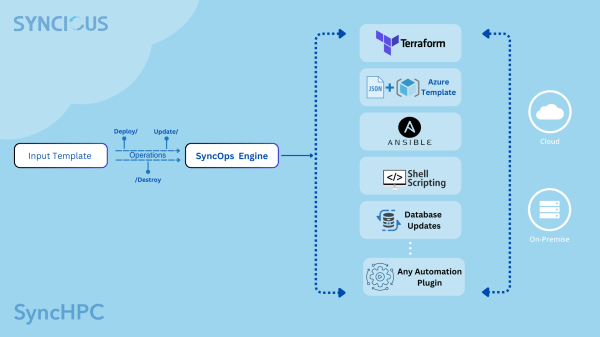
Do you know how SyncHPC works behind the scenes? For those immersed in the world of HPC / AI or VDI, understanding the inner workings of SyncHPC can unlock unlimited possibilities. SyncHPC platform is designed to deploy big compute workloads on cloud or on-premises. In this blog, we'll explain the orchestration engine of SyncHPC, exploring... Continue Reading →
Run Crash Simulations on SyncHPC: Radioss
‘SyncHPC’ platform helps users to easily deploy, manage and utilize their Public Cloud Clusters from any Cloud Service Providers like Microsoft Azure, Oracle Cloud Infrastructure and many more. It also allows users to run multiple CAE applications with required HPC and workstation configuration from cloud. Let’s check out an example with Altair Radioss: This blog... Continue Reading →
Run CONVERGE CFD, OpenFOAM and many more applications on SyncHPC Platform
Today, many researchers and makers are performing big computing jobs on Cloud High-Performance Computing Infrastructure to improve their productivity and to save huge budgets (CAPEX as well as OPEX). 'SyncHPC' by Syncious, allows users to effectively deploy, manage and run these applications on cloud. This blog post explains the end-user workflow to run one of... Continue Reading →
Running Ansys SPEOS on SyncHPC to utilize cloud HPC scalability
SyncHPC simplifies the lifecycle of multiple Ansys applications like ‘SPEOS’ (formerly OPTIS SPEOS) on Cloud-based high-performance computing (HPC) infrastructure. It provides easy deployment, management and usage of HPC resources for Ansys applications. This blog post describes the performance of ‘SPEOS’ on SyncHPC. It also briefly describes the end-user workflow of running ‘SPEOS’ application on this... Continue Reading →
Syncious Platform Receives ISO/IEC 27001:2013 Certificate
Syncious is excited to announce that we are now ISO/IEC 27001:2013 certified organization for information security standards. Security has always been of prime importance in our product development and operational processes. Our solution, SyncHPC, is designed considering enterprise-class security features. In accordance with TUV NORD CERT procedures, they have certified that Syncious Systems Private Limited applies a... Continue Reading →
Optimize Usage of High-End Workstations
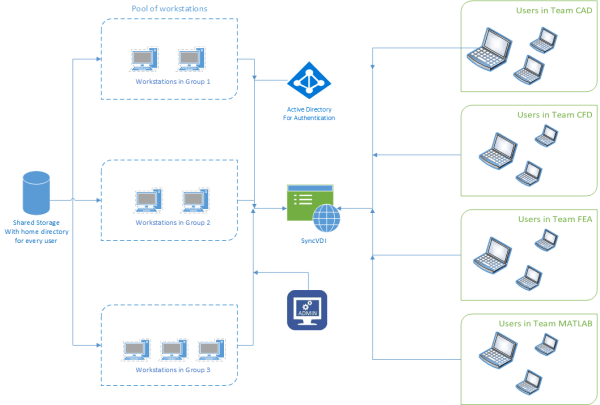
Syncious provides a solutions (SyncVDI) to effectively utilize high-end workstations within R&D teams. It helps to optimize budget and improve the productivity. Many organizations spend huge amount of capital and resources to procure and maintain high-end workstations for their R&D teams. Hence, they want to use their existing high-end workstations in effective manner. Also, they try... Continue Reading →
Performance of CUDA Progrms on Cloud based Machines with Graphic Processor
High-end graphic processor significantly increases the price of a workstation. Hence, if you want to run extremely compute intensive application on a graphic processor, then cloud can be an option. Syncious selected a simple but compute intensive problem to evaluate the performance of cloud based machines having graphic processor unit (GPU). The selected problem is... Continue Reading →
Weather Forecast using Cloud Computing with SyncHPC
Numerical weather prediction (NWP) system is designed to simulate and predict the atmosphere with a computer model. Weather Research and Forecasting (WRF) is a set of software applications used for this prediction. WRF is used extensively for research and real-time weather forecasting around the world. WRF application needs High Performance Computing (HPC) clusters connected using... Continue Reading →
ANSYS Mechanical performance on SyncHPC
Syncious team executed standard ANSYS Mechanical benchmarks on Syncious cloud platform (SyncHPC). Please find results below. Note: The graphs are plotted against ‘Solver Rating’. Solver Rating = 86400/solution time. Hence, higher the solver rating means better performance. Each problem was solved on 16, 32, 64 and 128 CPU cores. Please note that below examples are... Continue Reading →
Ansys CFX performance on SyncHPC
Standard HPC benchmark cases from Ansys CFX are selected to test performance and scalability of SyncHPC. This blog post presents the results of selected Ansys CFX cases on SyncHPC. Syncious team selected 2 cases from Ansys CFX: Airfoil-10M: Transonic flow around an airfoil. Global Mesh size: 9,933,000 nodes, 9,434,520 elements (all hexahedra) Syncious team configured... Continue Reading →
Introducing SyncAPI 1.0 : Get HPC capability instantly
Syncious is excited to announce release of SyncAPI 1.0 for users willing to add HPC capability in their applications. It allows instant connect from an application to HPC cluster. This HPC cluster can be deployed on public cloud or on-premise. SyncAPI significantly reduces time to market of HPC compatible applications. What is SyncAPI? It is... Continue Reading →
Ansys HFSS Analysis on SyncHPC
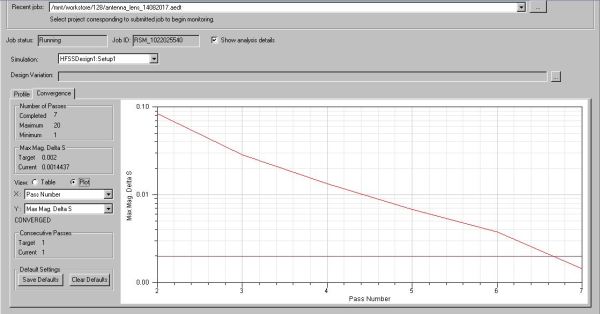
Ansys HFSS delivers 3-D full-wave accuracy for components to enable RF and high-speed design. Many times, HFSS needs High Performance Computing (HPC) infrastructure for complex problems. This blog post presents the performance of projects executed on Ansys HFSS using SyncHPC. In this experiment, team tried to design and analyze printed slotted antenna with dielectric hyperboloid lens.... Continue Reading →
Ansys Fluent, CFX on SyncHPC
Engineering teams of manufacturing industry use simulation products like Ansys Fluent. Many times such tools need HPC clusters to run simulations. Organizations try to solve two important aspects of HPC: Management of HPC clusters Simplify end-user HPC workflows. Recently, Syncious released a feature to submit Ansys Fluent and CFX jobs from SyncHPC user interface. This... Continue Reading →
Parallel File System (Lustre) on Public Cloud
This blog is about the basics of deploying and using a parallel file system on a public cloud. For this experiment, Lustre file system is selected on a public cloud Microsoft Azure. The easiest way to use Lustre in Azure is to deploy Intel Cloud Edition for Lustre on Microsoft Azure Virtual Machines. What is Lustre?... Continue Reading →
Cloud based HPC for Enterprise Users
Cloud based HPC is being considered by many large enterprises. These organizations are trying to reduce Total Cost of Ownership (TCO) of HPC systems. But, the seamless integration of cloud based HPC with on-premise systems is still a challenge. Syncious solution 'SyncHPC-E' tries to solve this problem. It supports features like user management, user access control, Active... Continue Reading →
Considerations for HPC Deployment Models
HPC infrastructure deployment and its maintenance is a costly affair. Hence, many of the organizations are evaluating an option of offloading their HPC workloads to cloud. But, the decision to choose between two is always complex and CIOs need to work on various aspects. Many organizations select one of the three HPC deployment models: 100% On-premise HPC 100% Cloud based... Continue Reading →
On-demand HPC Solution by Syncious
Syncious provides multiple solutions targeting HPC-As-A-Service. Family of solutions by Syncious towards HPC is called as SyncHPC. One of the solutions (SyncHPC-E) caters to large scale enterprises with multiple HPC user accounts. Another solution (SyncHPC-S) provides simplified workflow for individual users. This blog explains the workflow of SyncHPC-S. Small and medium businesses and academic sector... Continue Reading →
Performance Analysis of Public Cloud HPC Clusters with OpenFOAM Solver
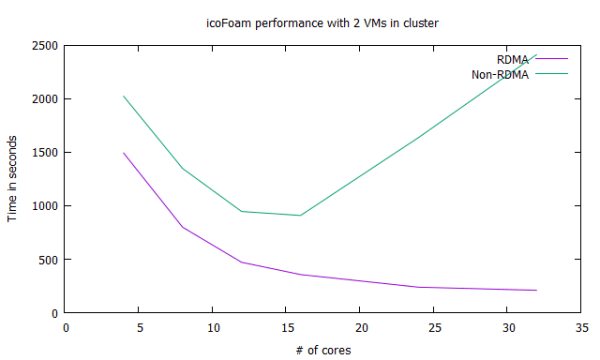
Syncious Team selected OpenFOAM as one of the applications to analyze Public Cloud based HPC Clusters. OpenFOAM (for "Open source Field Operation And Manipulation") is the free, open source software used to solve problems of computational fluid dynamics (CFD). Computational intensive CFD problems can be solved by using HPC clusters. Team referred the blog by... Continue Reading →
Benchmarking of Microsoft Azure Cloud for A9 and H16R based HPC clusters
Syncious team executed Intel IMB benchmark tests on Microsoft Azure compute servers (VMs). We selected VMs of type A9 and H16R. VMs of type H16R performs much better than type A9. We got lower latency numbers and higher throughput with H16R as compared with A9 series. Both A9 and H16 VMs support RDMA capability. If... Continue Reading →